Project Management: Prof. Dr. Roland Hardenberg (Frobenius Institute, Goethe University Frankfurt)
Project Staff: Shilanjani Bhattacharya, Bijayini Mohanty
Duration: January 2021 – December 2023
Funding: German Research Foundation
In recent decades, disciplines such as agricultural, plant, and food sciences, as well as various natural sciences have produced extensive knowledge about millets, especially about their health and nutritional properties, growing conditions, and environmental qualities such as their draught resistance. This knowledge has an immense impact on the development of new policies for meeting the Sustainable Development Goals (SDG) such as “zero hunger”, “good health and well-being”, “responsible consumption and production” and “climate action”.
In India, these policies are bein gimplemented by a variety of government institutions and non-governmental organizations. What effects do these policies, and the knowledge on which they are based, have for those people who produce, distribute and consume millets?
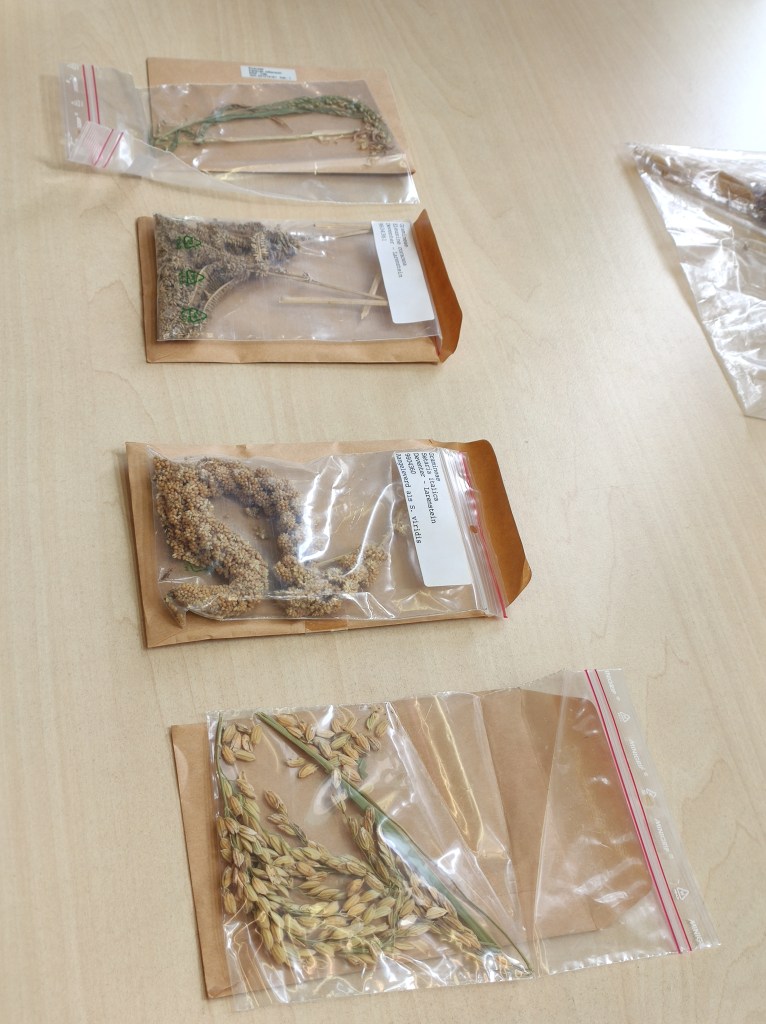
This project, which grew out of the Groningen-Frankfurt Millets Network (now Cereal Cultures Network) and is funded by the German Research Foundation (DFG) from January 2021 to December 2023, takes up this question using the example of Odisha, India, where international food policies have a major impact on local practices, evaluations, and forms of knowledge. The research focuses on the changing valuation and use of local millet varieties such as sorghum, pearl millet, finger millet, kodo millet, foxtail millet, or small millets. People use their own local language terms for these crops they grow, distribute, and consume. The corresponding categories and how they are embedded in everyday life are a central focus of this research.
This project encompasses three field studies that focus on understanding how urban elites, rural farmers, and mountain dwellers in Odisha each understand the ontological status of millets, their knowledge of millets, how they engage with the plants and their products, which material culture they use, what linkages exist between millets and social identities and to which policies they react. The results of these field studies will then be compared to understand possible connections between the respective contexts. Fundamental differences remain between the two “food worldvies”, each of which emphasizes food security or sovereignty.
 Cereal Cultures